Wednesday, 13 December 2017

Mike Rowe Answers Your Questions

Mike Rowe Answers Your Questions


Q: Are there any dirty jobs the producers want you to do that you have turned down? How much weight does your willingness to do a job really hold?
A: The producers of Dirty Jobs hate to hear the word "no." I can say this with certainty, because I am one of them. Therefore, I say "yes" more often than not, even when I am quietly repelled by the task at hand. Truth is, finding interesting jobs that are unusual and dirty is not all that easy. The producers, researchers and network types all collaborate about the show in general.
I am assured that from time to time, my opinions are considered.
Q: How did you end up in nothing more than a pair of boxers while on the sidewalks of San Francisco in the sewer inspector episode?
A: Well, it happened like this:
I was in San Francisco with two sewer inspectors, standing in the middle of Ellis Street, preparing to descend into the bowels of hell. Before doing so, I was instructed to don the proper wardrobe and safety gear, which required me to essentially strip. For city workers, this transformation can often occur in broad daylight, sometimes in heavy traffic. I merely took my cue from the work crew, and suited up. In fact, the segment originally opened with me standing in traffic, wearing very little, and saying to the camera, "Sewer inspectors don't get a dressing room." That scene was later removed. The brief outtake you saw was a remnant.
Q: When you were down in the sewer pits you had your mask off. Isn't it dangerous to inhale the bacteria and fumes in those sewers?
A: I spaced. To be honest, the situation was so horrific down there, and the heat was so suffocating, the thought of putting something over my face didn't occur to me. If I had it to do over again, I'd don the mask.
Actually, I wouldn't do it over again.
Q: Those pigs sure make a huge mess! How did you like working with pigs as experienced in the Pig Farmer episode? I understand that if given enough room, hogs will choose not to excrete waste where they eat and sleep. Confinement challenges that. Semi-confined hogs and pasture-raised hogs will not be as dirty as confined hogs.
A: The smell was indescribable. And the myth that pigs are actually a "clean" animal is a myth.
You're right, though. I don't mean to suggest that the pigs are to blame for their appearance or bouquet. As one who has been smeared with poo from many species, they have my empathy in that regard.
Q: I saw the Teutuls on CNBC the week of the Pig Farmer episode. They had nothing but good things to say about you, Mike. Are you acquainted with them?
I've been doing the opening voice-over on American Chopper from the beginning — those Teutuls had better be nice ...

Bennelong's heart: the diverse district that's key to winning byelection

Bennelong's heart: the diverse district that's key to winning byelection


Who will make the cut? Eastwood is in the centre of the hotly contested seat of Bennelong. Photograph: Mike Bowers for the Guardian
In Rowe Street, Eastwood, elderly women sized up the bok choy at the outdoor markets and chatted outside shops displaying glossy roast ducks.
Eastwood, in the north-west of Sydney and once home to Granny Smith apples, is at the heart of the federal seat of Bennelong. It has transformed from a lower-middle-class white commuter suburb to a vibrant middle-class multicultural area that prides itself on its harmoniousness. The seat is considered one of the most diverse in Australia, with the 2016 census recording that 21% of the electorate identified some Chinese heritage, 4.7% Korean and 34% Australian, English or Irish.
But now it holds the key to Malcolm Turnbull’s political future and possibly Bill Shorten’s as well.
When the voters go to the polls for a byelection on Saturday, they will be deciding whether the Turnbull government clings on to its one-seat majority, or is forced to rely on independents to govern.
When the Guardian visited this week, a few themes emerged. Both candidates were well known to voters, showing that the Liberals’ John Alexander has put in the hard work over the past seven years and that Labor’s decision to run the former NSW premier Kristina Keneally is also working.
On the streets of Eastwood, when asked what would drive their vote, most people nominated the sort of things any other Sydneysider would nominate: congestion, transport issues, health and education services.
Voters downplayed the role played by cultural voting blocs, Turnbull’s China rhetoric and Sam Dastyari’s resignation. In fact, most didn’t realise what had happened at all.
A man chops roast pork in Eastwood, an area in the heart of Bennelong with a large Chinese community. Photograph: Mike Bowers for the Guardian
Seated in the basement of the Eastwood Centre – which is owned by the Chinese billionaire at the centre of the Dastyari scandal, Huang Xiangmo – Peter Wong said it wasn’t something the Chinese community cared about.
As an older Australian, he said, he was “interested in the issue of Medicare”.
“John Alexander, in the past, he might be not quite looking after the elderly, in my mind,” he said.
James, who declined to provide a last name, said he had not heard of Dastyari’s Chinese links, Turnbull’s attack or the fallout.
“I don’t think the Chinese community are going to follow it that much,” he said. “I know there are major Chinese newspapers, so if that’s a headline on it, then maybe it will make an impact. I wouldn’t care myself.”
Some of the Chinese language newspapers, which routinely reproduce stories from the Beijing newspapers, have carried articles putting the Chinese government perspective that Turnbull has overreacted on the question of Chinese interference, is leaning towards racism in his rhetoric and putting the relationship at risk.
But whether these are influential remains to be seen.
“[Turnbull’s] talking about bad Chinese people, a Chinese guy who supported one of the politicians,” said Danny Pang. “But Chinese people and the Chinese community here are two different things.”
Anita, who migrated from China 20 years ago, said she didn’t think her community voted as a bloc anyway. It was wrong to assume that one issue would sway the community, she said.
“I think they vote differently, because they have their own ideas,” she said. “Maybe they are Christian and they support the Christian candidate. Maybe they support the one who has really done something for the past year. It’s different.”
A Newspoll conducted last weekend put Liberals and Labor neck and neck, at 50% each on the two-party preferred vote. It used phone interviews of 527 voters and has a margin of error of 4.3%.
The Fairfax ReachTel poll taken on Tuesday – the day Dastyari resigned – put Alexander comfortably ahead of Keneally on 53-47, two-party preferred. It used robocalls and was based on 864 responses, giving an error rate of 3.5%.
It’s an open question whether either method is accurate when a substantial number of voters speak English as a second language.
What is known about Bennelong is that it is more conservative than other parts of Sydney. In the same-sex marriage survey, Bennelong voted no 50.2% to 49.8%.
Inspecting fresh produce in Eastwood, a multicultural middle-class suburb. Photograph: Mike Bowers for the Guardian
For Keneally, a win in Bennelong would be both a blessing and a curse.
A win will commit her to a constant round of barbecues, school fetes and probably a move to the electorate. She currently lives on the boundary in Boronia Park, but the family has recently bought a house on Scotland Island in Pittwater in Sydney’s north, and Keneally had planned to spend more time in Canberra for Sky TV.
But the bigger problem will be the nature of the seat itself. Demographics and redistributions westward made Bennelong – once safely Liberal – increasingly marginal during the 1990s and 2000s.
When the seat’s longtime MP and then prime minister John Howard was defeated by the high-profile Maxine McKew in 2004, it was Labor’s first win there. But McKew was unable to hold it more than one term, despite a mighty effort.
Changing demographics are probably again making Bennelong more safely conservative. This election, a Chinese Christian, Cao Gui Dong, is running for the Christian Democrats for the first time. A boost to the party’s primary vote – which hit 6% last year – could point to a growing Chinese and Korean population with more conservative, religious ties.
If Keneally loses, she may well end up taking the Senate spot vacated by Dastyari. Or she may return to Sky, with the Labor party forever in her debt, while she awaits another opportunity.
The top Senate spot for Labor in NSW would certainly be an easier gig, as would a mooted tilt at the new seat in Canberra.
The government has attempted to make much of Keneally’s plan B. But in Rowe Street, Eastwood, it didn’t rate a mention.

Mike Rowe’s crew visits Jackson’s ComeUnity Cafe

Mike Rowe’s crew visits Jackson’s ComeUnity Cafe

JACKSON, Tenn-A local cafe got a surprise visit this afternoon after a recommendation from one of their own.
ComeUnity Cafe in downtown Jackson was one stop for the production crew of Mike Rowe’s online project that highlights businesses giving back to their communities.
“It is the Jackson community that made this place happen. A couple months ago, probably four or five months ago, we were having some really dry days. Not a whole lot of money coming in. We work on donations. I just took a step and posted on Facebook, ‘hey Jackson, this is your cafe,'” said Amy Crenshaw, founder of ComeUnity Cafe.
Crenshaw said after that Facebook post, the cafe received numerous donations and more customers from around Jackson visiting the restaurant.The episode is a part of Mike Rowe’s “Returning the favor” series on Facebook.

Girl Scouts make ‘Birthday Boxes’ for emergency shelter

Girl Scouts make ‘Birthday Boxes’ for emergency shelter


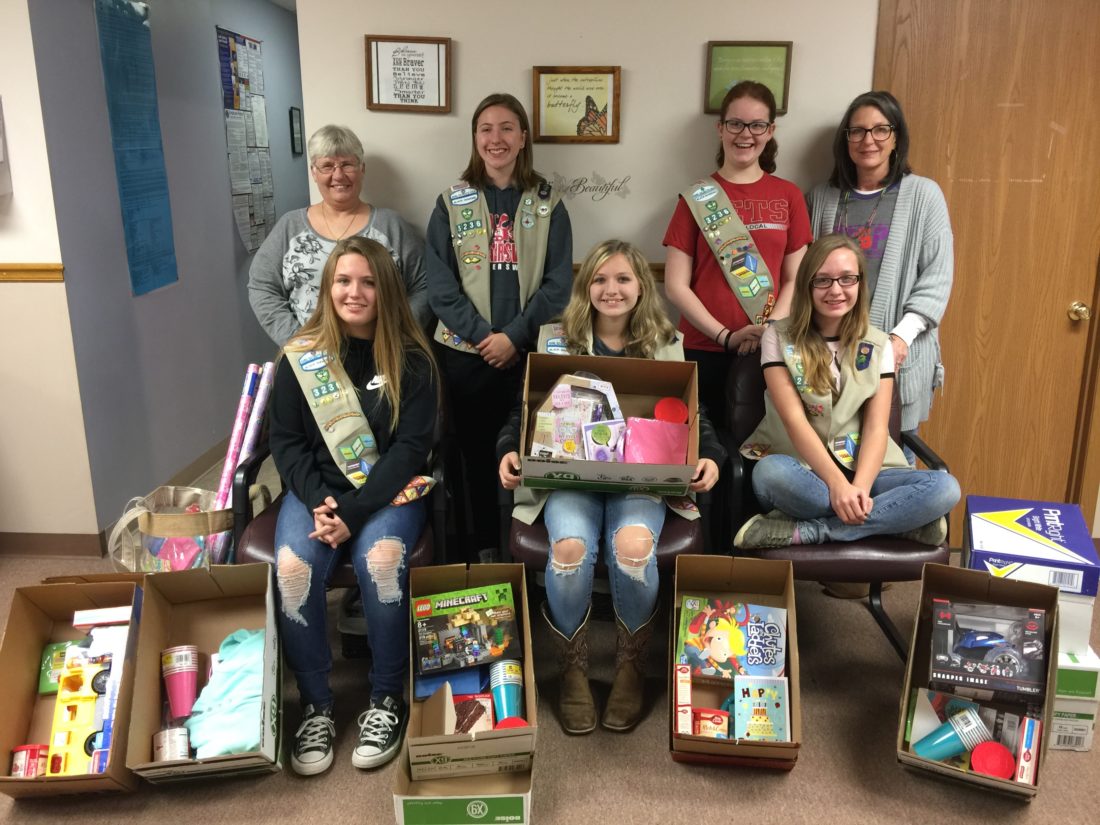
GIRL SCOUT Troop 3236, led by Becky McLeod and Holly Loy, put together “Birthday Boxes” for children who are residents of Peg’s House, Tri-County Help Center’s Emergency Shelter for domestic violence victims and their children. Standing, from left, are Darlene Bruce, shelter advocate, Emma Sroka, Gwendolyn Kovacs and Cathy Campbell, executive director. Sitting, from left, are Mallary Jeffers, Johnna Sroka and Kaitlyn Grace. Contributing but not pictured was troop member Emily Schmidli.
ST. CLAIRSVILLE — Girl Scout Troop 3236 recently put together “Birthday Boxes” for children who are residents of Peg’s House, Tri-County Help Center’s Emergency Shelter for domestic violence victims and their children.
Each box contains a gift, cake and icing mix, decorations and wrapping paper so the parent in the shelter can feel involved with celebrating their child’s birthday.
The troop’s leaders, Becky McLeod and Holly Loy, helped participating troop members, including Emma Sroka, Gwendolyn Kovacs, Mallary Jeffers, Johnna Sroka, Kaitlyn Grace and Emily Schmidli.
Tri-County Help Center Inc. is a private, nonprofit contract agency of the Mental Health and Recovery Board serving Belmont, Monroe, and Harrison counties in Ohio.
Peg’s House Emergency Shelter offers free emergency shelter for survivors of domestic violence, sexual assault and stalking. At Peg’s House, people are supported by trained and caring staff members who are dedicated to helping survivors and their children in a safe and confidential environment.
The shelter is able to provide food, transportation, clothing, and personal care products. The shelter can also provide assistance obtaining housing, safety planning, and crisis intervention, and connect people with services such as counseling and court advocacy, as well as other community resources.

Clothing business uses young girls in vulgar videos to raise money for Planned Parenthood, LGBT causes

Clothing business uses young girls in vulgar videos to raise money for Planned Parenthood, LGBT causes

COLUMBUS, Ohio, December 7, 2017 (LifeSiteNews) – A clothing company has exploited girls as young as six to make obscenity-laden videos advertising its feminist, anti-Trump merchandise.
FCKH8.com is a T-shirt company that caters to consumers who support left-wing causes. The videos with the young girls appear on the company’s website alongside advertising photos with near-naked men.
FCKH8.com achieved notoriety in 2014 with a video entitled “Potty-mouthed Princesses.” In that advertisement, little girls ages 6 to 13 let loose a tirade of profanity-laden thoughts on such adult topics as wage disparity, sexual assault, and rape.
FCKH8.com is owned by Synergy Media, a for-profit marketing company. According to its website, FCKH8 “has raised over $280,000 for equality causes, arming thousands of people with pro-LGBT equality, anti-racism and anti-sexism T-shirts that act as ‘mini-billboards’ for progress.”
The company is now selling pink “pussy hats” and related T-shirts through a website called PussyScouts. In an online advertisement released yesterday, pre-pubescent girls in pink “pussy hats” and mock Girl Scout uniforms perform an obscenity-laced “rap” about Donald Trump.
(The video, which LifeSite cannot embed because of its graphic nature, is on YouTube here.)
“Oh, Scouts, oh, Scouts,” trills an elderly woman in a pink uniform, “ready for your song about President Trump?”
The camera cuts to an actor in a papier-mache Trump mask patting someone in a KKK uniform on the back.
The cheering girls begin their rap, alternating lines.
“Granny be droppin’ a beat that’s sick.
“We’re gonna rap about a prez who’s a sexist d***
“Ya call women ‘fat pigs,’ show us no respect.
“Try to grab my p***? You’re gonna get wrecked.”
(At this a snarling girl drives a fist into the palm of her fake fingernail-adorned hand.)
“Cuttin’ Planned Parenthood healthcare,
“An agenda more ****ed than your ****ed-up hair.”
(Here a girl makes an obscene gesture with both hands.)
“You said of ladies, you gotta ‘treat ‘em like ****
“Accused rapist, sex assault culprit.
“Like Princess Leia choked out Jabba the Hutt
“The Women’s March showed women’s mouths can’t be shut.”
“Super callous fraudster rapist sexist not my POTUS.
“Bull**** racist Muslim ban
“You’re loved by Nazis and the Ka-Ka-Klan … ”
Near the end of the video, an adult woman points to the pink “pussy hat” on her head, calling it “a powerful symbol of the fight for equality.” She encourages viewers to buy a similar hat or one of a line of T-shirts. A “Pussy Scout” hat normally retails for $14.99.
In American slang, the word “pussy” is both an archaic diminutive for a cat and an obscene expression for women’s genitalia. The pink hat, which also represents women’s genitalia, was adopted by anti-Trump activists at the pro-abortion “Women’s March on Washington” in January 2017. The U.S. president was recorded using the word in a lewd conversation in 2005.
FCKH8.com has produced another profanity-laced video for its own website. Here a stereotypical white American “Southerner” argues with children for the survival of the Confederate flag.
The advertisements are “disgusting and abusive,” Fiorella Nash, a mother of two young daughters, told LifeSiteNews. “Commandeering children for political causes is wrong whatever the cause. They have a right to be children.”
A veteran pro-life campaigner, Nash has traveled across the United Kingdom to build awareness of the worldwide “gendercide” against unborn baby girls. She believes that children don’t need lewdness to communicate confidence.
“I want my children, male and female, to grow up respectful, courteous, and capable of putting across a strong argument intelligently,” Nash said.  
FCKH8 has future plans for the “Pussy Scouts.” According to its website, it will soon sell “Pussy Scout cookies.” Some of the cookies pictured resemble the “pussy hats.” Others are frankly modeled on female genitalia. One hundred percent of the proceeds from the cookies will go to Planned Parenthood.  

In Maryland prison, Girl Scouts get to visit with their moms

In Maryland prison, Girl Scouts get to visit with their moms


JESSUP, Md. (AP) — Nine-year-old Kuhmaria VanBuren ran into the prison gymnasium and jumped into her mother’s arms with so much force they almost fell down.
For the next two hours, Kuhmaria let her mom braid her hair and cuddled in her arms, savoring the rare contact. Sapphire VanBuren, 26, has been incarcerated at the Maryland Correctional Institution for Women for over two years.
The VanBurens are among 30 mother-daughter pairs who come together at the Jessup prison twice a month through the Girl Scouts Beyond Bars program. The initiative, now in its 25th year, aims to foster bonds between young girls and their moms, even as metal detectors, locked gates and guards separate them most days of the year.
“It’s wonderful just being able to be in her life, despite the circumstances,” VanBuren said.
Administrators say the program helps boost the girls’ self-esteem and provides them with a community of other children who understand what it’s like to grow up with a mom in prison. For the mothers, the visits are a connection to life outside the prison walls, and an incentive to get through their sentence without trouble.
The Girl Scouts of Central Maryland was the first to create such a troop, but over the next two decades, the model was duplicated in over two dozen Girl Scout councils across the country. Since 1992, the Central Maryland council has served more than 400 girls and their mothers. Roughly a third of the girls this year, including Kuhmaria, live in Baltimore.
When a woman is sent to prison, it breaks up the family, said Margaret Chippendale, the prison’s warden. “This is just the opportunity to help stop that breakage, to bring mom and daughter back together,” she said. “Incarceration is tough — it’s tough for mom, but it’s really tough on children and the families that’ve been left behind.”
Women represent the fastest growing population of prisoners in the country — increasing 14-fold between 1970 and 2014, according to one recent study. Two-thirds of incarcerated women leave behind at least one child, other figures show.
VanBuren has awhile to go on her 12-year sentence for assault, and is grateful she gets to watch her daughter grow up.
“It’s the reason why I keep pushing in here, why I stay out of trouble,” VanBuren said. “It’s all to get home to her.”
The hair-braiding, hugging and hand holding are among the most visible ways these two-hour sessions differ from a traditional prison visit.
During regular visitation, the inmate and the visitor sit on opposite sides of a table. There is no touching, save for a brief embrace that’s permitted at the very end of the hour. A policy put into effect in 2015 across all Maryland correctional facilities bans touching at the beginning of a visit, kissing on the mouth and taking pictures, an effort to crack down on contraband exchanged during visitation.
In a Girl Scouts session, some of the young girls cling to their mothers for nearly the entire two hours.
Many of the mothers are dressed in the standard uniform — gray pants and a gray long-sleeve shirt. The girls, meanwhile, usually come in the khaki pants, white shirts and sashes that signify their Girl Scout rank.
Cailyn Moreno, 14, and her sister, eight-year-old Ciara Wiseman, treasure the time they can spend telling their mother about their day-to-day life. Ciara brags to their mother, Amanda Cooper, about how she can do eight cartwheels in a row. Cailyn asks for advice about boys at school and tells her mom how she’s considering a career in pediatric surgery — she’s been watching a lot of “Grey’s Anatomy” lately.
But the sessions aren’t only a time to catch up with mom, program officials say. The girls also take part in more traditional scouting activities.
The girls set up a cookie selling station next to a metal detector in the visitors lobby. The troop has raised thousands of dollars selling Tagalongs, Thin Mints and Lemonades to others in the visitors center.
After finishing up sales, the girls know the routine: Go through the metal detector, lift your arms, get patted down by an officer, allow the K-9s to sniff around your feet.
Inside the prison gymnasium, after some free time for catching up, everyone stands together for a friendship circle. They sing “Happy Birthday” to those with a November birthday, and they share special news. One girl talks about being named to the Honor Roll. Kuhmaria tells the group she got a new kitten named Prince Charming. Together, mothers and daughters recite the Girl Scout Promise and the Girl Scout Law — “I will do my best to be honest and fair, friendly and helpful, considerate and caring, courageous and strong, and responsible for what I say and do.”
Then the girls break up into age-appropriate clusters, joined by their moms, for activities. One group talks about working toward their Silver Award. Another discusses philanthropy and plays get-to-know-you games.
During one game, the girls are instructed to find out “fun facts” about their moms and each other.
Kuhmaria turns to her mother to ask what her fun fact is. “I love you more today than I did yesterday,” VanBuren says.
One of the most treasured parts of the program, the girls say, is the annual sleepover. For an entire night, the moms and daughters can hang out, painting nails and watching movies, and get a brief taste of normalcy.
Cailyn remembers staying up all night for the sleepover — prompting her mother to yell at her to go to bed.
“It was kind of nice to be yelled at again,” Cailyn said.
For some girls, it is the first full night they’ve ever spent with their mothers. An estimated one in 25 women is pregnant at the time she is sent to prison.
The program took a financial hit in 2012, when the U.S. Department of Justice stopped awarding money to the national Beyond Bars initiative. The Central Maryland council received federal dollars each year from 2002 to 2012, but now relies on other grants and donations. Some programs elsewhere ended. About 15 councils still have programs, Girl Scouts officials say.
At the end of a recent visit, everyone gathered in a circle again to talk about what they are thankful for. The mothers and daughters would again be celebrating Thanksgiving apart.
“I’m thankful for my mommy,” one girl said. “For my support system,” said another. “For Girl Scouts,” a few girls chimed in.
When it came time for goodbyes, moms peppered their daughters’ faces with kisses, and reached out for second and third hugs.
Through windows that overlook the prison’s gymnasium, some of the women waved both hands while their daughters slowly disappeared from view. The daughters, turning back, blew kisses until they were escorted past the windows, and through a locked door.
Copyright © 2017 The Associated Press. All rights reserved. This material may not be published, broadcast, written or redistributed.

Satisfy Your Girl Scout Cookie Cravings Year-Round With This New Yogurt!

Satisfy Your Girl Scout Cookie Cravings Year-Round With This New Yogurt!

You can finally feel a little bit better about your decision to have Girl Scout cookies for breakfast, because they now exist in yogurt form! Yoplait has just announced the launch of three new yogurts inspired by the most popular Girl Scout cookie flavors: Thin Mints, Peanut Butter Chocolate, and Caramel Coconut. Instead of devouring a sleeve of cookies in just a day or two, we think we might be excited to reach for these instead.
The new yogurts come in two textures: the Thin Mints and Peanut Butter Chocolate flavors are Yoplait Whips!, meaning they have a fluffy mousse texture. The Caramel Coconut flavor is a Yoplait Original yogurt, so it's more smooth and creamy. The best part is these Girl Scouts-approved yogurts aren't a limited edition — they're here to stay. The three new flavors will hit store shelves starting in December, and all of them are now permanent, year-round additions to the Yoplait lineup. Excuse us while we go stock up to satisfy our cravings until Girl Scout cookie season officially starts!

American Girl dolls available to borrow at libraries, thanks to Girl Scout's savvy

American Girl dolls available to borrow at libraries, thanks to Girl Scout's savvy


A New York Girl Scout is giving hundreds of kids the chance to play with a childhood staple, the American Girl doll, by creating a lending program for the dolls at local libraries.
Olivia Reduto, 14, of Edgemont, New York, spent the past year raising nearly $800 so she could purchase six American Girl dolls and accessories for the dolls.
Olivia Reduto traveled to the American Girl store in New York City to purchase dolls for her local library.
Olivia, a ninth-grader who has been in the Girl Scouts since the first-grade, then donated two dolls each to three libraries within the Yonkers Public Library system just north of New York City.
The dolls, which can be checked out for a three-week period, already have a waiting list after being introduced this fall.
Olivia Reduto reads an American Girl story to younger Girl Scouts.
“It’s been overwhelming,” Tara Somersall, head of children’s services at Riverfront Library in Yonkers, said of the response. “One girl who checked a doll out from us last week, she left here skipping.”
Somersall added of the appeal, “Because American Girl dolls come in different ethnicities, looking at these dolls, a lot of little girls can relate to them.”
Olivia studied the demographics of each individual library in order to make sure each American Girl doll she donated was a doll the library’s patrons could identify with. American Girl dolls come with their books to explain their life story and represent a variety of backgrounds and historical eras.
“I have three main points of my project,” said Olivia, who earned a Girl Scouts’ Silver Award for the project. “One is diversity, one is to get kids excited about history and reading and one is about income inequality.”
She continued, “So I chose different types of dolls from different cultures and ones that had a certain history and certain years and worked with the library to pick them out.”
American Girl dolls are available for three-week loans at Yonkers Public Library. An American Girl doll available to be checked out at a Yonkers Public Library is pictured here.
Olivia was inspired after reading an article about the Ottendorfer branch of the New York Public Library, which has been lending American Girl dolls for several years.
Olivia Reduto, left, poses with Thea Taube, Children's Librarian at Ottendorfer Branch of the New York Public Library, whose American Girl dolls project inspired Reduto.
She held tea parties for younger Girl Scouts and worked at a Girl Scouts tag sale to raise money. Most American Girl dolls sell for more than $100, with accessories costing even more.
After Olivia had enough money raised to purchase the dolls, she went on a shopping spree at the American Girl flagship store in New York City. Olivia's mom, Tina Reduto, also won a raffle through the store for a free American Girl doll that they are donating to a fourth local library.
Olivia Reduto donated six American Girl dolls to Yonkers Public Library.
American Girl has no official doll lending program for libraries but supports the individual efforts by people like Olivia, the company told ABC News.
“Children have been checking out American Girl books and reading about the adventures of their favorite characters from long ago and today for more than 30 years at their local libraries,” the company said in a statement. “It’s thrilling to see the growing number of libraries that are now adding American Girl dolls to their lending collections as well. Libraries encourage a lifelong love of reading, curiosity, and learning, so we’re proud that our American Girl dolls and books can be a part of these efforts.”
Somersall, of the Riverfront Library, said the library, which represents a lower income area, would not have been able to provide their patrons with American Girl dolls without Olivia's help.
"One mom said she couldn’t believe it because, otherwise, she wouldn’t have been able to afford [a doll] for her daughter," Somersall said. "Just to have the dolls now along with the books, the caregiver can go home and have background to share about the doll and it encourages the kids to read, too."

Tragedy strikes the American Girl Store on 'SNL,' but everyone is fixated on this one dude

Tragedy strikes the American Girl Store on 'SNL,' but everyone is fixated on this one dude


Saturday Night Live checked in with shoppers after an underground gas main exploded at a Phoenix American Girl Store, and boy were they shaken up.
Reporter Ben Hartley (Kenan Thompson) spoke with customers Debbie Pritchard, a mother shopping with her daughter (played by Lady Bird’s Saoirse Ronan,) and Thomas Dean (Mikey Day) a grown-ass man who was just, you know, shopping for a doll. Alone.
They recounted the horrific experience of the explosion, explaining what brought each of them to the store to begin with.
Though Dean claimed he was “buying a gift” his weird doll obsession wound up overshadowing the explosion, and it wasn’t long before Hartley uncovered the real story: Grown Man Frequents American Girl Store Alone with Beloved Doll.

Grand Rapids, MI: Family Demands Answers After Police Handcuff, Detain 11-Year-Old Black Girl

Grand Rapids, MI: Family Demands Answers After Police Handcuff, Detain 11-Year-Old Black Girl


We begin today’s show in Alabama, where in a stunning upset Democrat Doug Jones defeated Republican Roy Moore in the controversial race to fill the Alabama Senate seat left vacant by Attorney General Jeff Sessions. With 100 percent of the vote tallied, Jones led Moore by nearly 21,000 votes, a margin of 1.5 percentage points. Jones addressed supporters in a victory speech Tuesday night.
Sen.-elect Doug Jones: “At the end of the day, this entire race has been about dignity and respect. This campaign has been about the rule of law. This campaign has been about common courtesy and decency, and making sure everyone in this state, regardless of which ZIP code you live in, is going to get a fair shake in life.”
Jones’s victory marks the first time in 25 years that a Democrat has won a U.S. Senate race in Alabama. Tuesday’s special election was highly controversial, pitting Doug Jones against Roy Moore—an accused pedophile with a long history of racism, sexism, homophobia and Islamophobia. Roy Moore has so far refused to concede the race, and on Tuesday night called for a recount. But President Donald Trump, who had repeatedly endorsed Roy Moore, did acknowledge Moore’s defeat, tweeting: “Congratulations to Doug Jones on a hard fought victory. The write-in votes played a very big factor, but a win is a win. The people of Alabama are great, and the Republicans will have another shot at this seat in a very short period of time. It never ends!”
Tuesday’s vote was highly divided by race and gender, with African-American voters, particularly women, largely responsible for defeating Roy Moore. Overall, 96 percent of African-American voters voted for Doug Jones, with a staggering 98 percent of all black women voters voting for Jones. In contrast, nearly 70 percent of white voters voted for Roy Moore. A full 63 percent of white women voted for Moore, despite Moore being accused by multiple women of sexually harassing or assaulting them when they were teenagers. Democratic strategist Symone Sanders, who served as Vermont Senator Bernie Sanders’s press secretary during his presidential campaign, said, “Doug Jones would not have won today without the turnout we saw from African-American voters. … Black women have been absolutely clear in their support for Democratic policies and Democratic candidates. It’s high time for Democrats to invest in that effort.” Doug Jones’s victory means the Republicans’ majority in the Senate will narrow to 51-49.
We’ll have more on the Alabama special election after headlines.